
Table of Contents
- Underestimating Mandatory Transaction Fees & Closing Costs
- Overlooking Ongoing RERA Service Charges
- Confusing Freehold and Leasehold Zones
- Failing to Vet Developer Escrow Accounts on Off-Plan Purchases
- Rushing the Form F (Memorandum of Understanding)
- Ignoring The Interior Arrangement, Structural Flow and Snagging
- Working with Unlicensed Brokers Instead of RERA-Certified Agents
- Misjudging Mortgage Pre-Approval and Interest Rate Structures
- Overlooking the Hidden Cost of Renovation and Turnkey Fit-Outs
- 10 Assuming Every Property Automatically Grants a Long-Term Residency Visa
- Actionable Rules: What Not to Do When Buying Your First Home in Dubai
- FAQs
- 1 Can a real realtor legally charge more than 2% commission in Dubai?
- 2 If I buy a rented property, can I move in immediately after transfer?
- 3 What are the top pitfalls for first-time property buyers in Dubai to watch for?
- What are the key mistakes to avoid when buying property in Dubai for the first time on a mortgage?
- What happens if my mortgage valuation comes back lower than the agreed price, but I didn’t add a clause to Form F?
You have saved your 20% deposit, and discovered the beautiful apartment in Dubai Marina or Downtown is ready to put down the contract but why are your savings disappearing before the keys are even handed over?
One of the most common mistakes first-time buyers make in Dubai is assuming purchasing real estate here is as simple as meeting the asking price, only to discover that unbudgeted upfront charges can delay registration or completely derail cash flow.
While I was looking at the purchase risks, market data published by the Dubai Land Department, along with transaction analysis conducted by Dubai’s major brokerage advisories, show that cost regulatory in nature, averaging 7% to 8%, are stacked onto the purchase price. In addition to the purchase price, the buyer must bear the mandatory 4% DLD transfer cost, trustee registration fees (AED4,000+ VAT), real estate agency commission (2% + VAT), mortgage registration (0.25%) and developer NOC costs.
Buyers purchasing ready AED 2 million apartment who neglect to consider the extra regulatory costs on transfer will be AED 140,000-160,000 short at the transfer table.
You’d probably feel that tension when you are desperately trying to own a Dubai home that you have always loved and longed to own.
To keep things process smooth, the smartest trick is to pinpoint the most common mistakes first-time buyers make in Dubai. Before signing examine these common pitfalls step by step so you can protect your equity, negotiate with clarity, and make an informed investment.

1. Underestimating Mandatory Transaction Fees & Closing Costs
The single biggest shock for you is to assume that the deposit is the only cash needed upfront. In secondary resale transactions, the 4% DLD registration fee is technically a 50/50 split between buyer and seller by regulation, but standard market convention places the entire 4% on the buyer.
When you factor in the 2% brokerage commission (+ 5% VAT), valuation fees (AED 2,500–3,500), and mortgage processing fees, failing to budget this extra 7% to 8% can freeze your mortgage draw down at the registration trustee office.
To keep the process smooth, understanding the most common mistakes first-time buyers make in Dubai helps you protect your equity.
2. Overlooking Ongoing RERA Service Charges
You may get a good deal on a property but that’s just a piece of the puzzle. Rents and the net yield or monthly affordability will also vary depending on the annual maintenance charges. The Real Estate Regulatory Agency (RERA) controls service charges by square foot in the trade Service Charge Index.
For ultra luxury condos on the beach or at towers a super tall with pools, chiller storage, and a resort-like allure, average annual costs range between AED 25-65 per sqft. The purchase of a 1,500 sq. Ft. Apartment without visiting the mollak portal could slam an extra AED 40,000+ annual charge on your plate. Missing this is one of the most common mistakes first-time buyers make in Dubai.
3. Confusing Freehold and Leasehold Zones
Dubai has well-defined legal zones where foreign ownership is permitted:
- Freehold Areas such as Palm Jumeirah, Downtown Dubai, Dubai Hills Estate include freehold ownership of the unit and the land on which it is built for an unlimited period.
- Leasehold Land items of land granted a property interest for a defined period, though not featuring ownership of the land beneath the property.
Acquiring a property on a presumed freehold basis within a restricted or leasehold enclave is one of the most common mistakes first-time buyers make in Dubai, and may restrict exit liquidity and capital appreciation in the future.
4. Failing to Vet Developer Escrow Accounts on Off-Plan Purchases
Off-plan properties are appealing because of phased payment plans and lower entry pricing. However, one of the top pitfalls for first-time property buyers in Dubai is signing agreements without verifying whether the developer’s escrow account is formally registered under Law No. (8) of 2007.
Law requires that investor funds be held in a DLD-monitored escrow account dedicated solely to that project’s construction milestones. Purchasing through unlicensed sales channels or wiring funds directly into non-escrow company accounts can strips away your regulatory protection in the event of construction delays.
5. Rushing the Form F (Memorandum of Understanding)
In Dubai, the formal contract between a buyer and a seller is called Form F or the Memorandum of Understanding, this document is legally binding once signed.
Many buyers treat this as a standard, boilerplate template and simply sign where the agent tells them to. This is exactly what not to do when buying your first home in Dubai.
One of the most common mistakes first-time buyers make in Dubai is signing Form F without inserting essential financing or property inspection possibility. If your mortgage approval falls through due to a down-valuation by the bank, or if the seller has uncleared service charge arrears that block the developer NOC, you risk forfeiting your initial 10% security deposit without clear contractual escape clauses.
6. Ignoring The Interior Arrangement, Structural Flow and Snagging
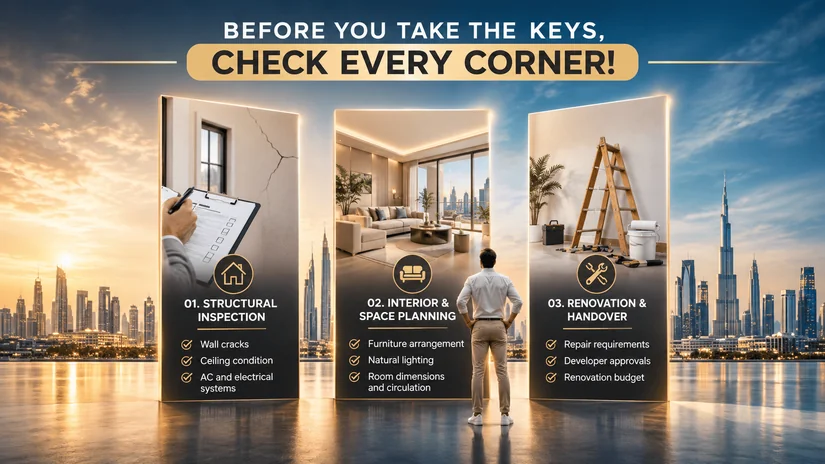
A classic example of Dubai real estate mistakes made by beginners is skipping professional snagging inspection in Dubai before the final handover documentation. New build off-plan projects can have crooked joinery, leaky AC coils, hairline plaster cracks and uneven MEP installations.
Check the architectural envelope so you don’t have to take on hundreds of thousands of dirhams of corrective maintenance.
Know how architectural plans influence daylight, circulation and scale of furnishings can transform a floorplan. Reviewing established luxury interior design styles helps you evaluate whether a property’s ceiling clearances, structural columns, and room dimensions match your lifestyle before you make an offer.
7. Working with Unlicensed Brokers Instead of RERA-Certified Agents
One of the most common mistakes first-time buyers make in Dubai is trusting unlicensed brokers. Some brokers are not authorized to work in the real estate industry in Dubai. When you work with a freelance broker that is not regulated, you may run the risk of posting defective yields, missing legal requirements, and publishing listings that are illegal.
To avoid this, work solely with MAF homeowners and well-known top interior design firms in Dubai and ensures that you have a valid RERA card.
8. Misjudging Mortgage Pre-Approval and Interest Rate Structures
Window-shopping properties without formal banking pre-approvals has always been one of the most common mistakes first-time buyers make in Dubai. According to the most recent UAE Central Bank regulation, expatriates who buy their first property for an AED 5,000,000 or less can access a maximum 80% loan-to-value (LTV) with at least 20% equity upfront (a down payment), while secondary property LTVs can only be 60-65%.
In addition, banks will charge early settlement fees and require valuation reports of assets in order to fund so avoiding these Dubai real estate mistakes made by beginners ensures you don’t face unexpected repair bills.
9. Overlooking the Hidden Cost of Renovation and Turnkey Fit-Outs
Many first time buyers purchase older secondary apartments in established master developments such as The Springs, Arabian Ranches or in older Dubai Marina towers with plans to renovate immediately.
But older units often need complete replumbing, upgrading of electrical panels, the removal of antiquated AC compressors, and approval from the developer (including getting an NOC from a master developer such as Emaar or Nakheel in addition to Dubai Municipality permits).
Engaging with an experienced modern interior design firm in Dubai guides in the old clause- you get the approximate amount of civil modifications, material details, and authority approvals or if you consult with the best interior design firm in Dubai it will helps you map out accurate fit-out scopes and civil alteration budgets before you commit capital.
10 Assuming Every Property Automatically Grants a Long-Term Residency Visa
Dubai allows residency through a property investment but there are statutory thresholds:
- 2-Year Property Investor Visa: Must have at least AED 750,000 unrestricted equity/purchase price in a ready residential property.
- 10-Year Golden Visa: Investment of AED 2,000,000 (cash or mortgage through locally approved banks or in advance off-plan via approved developers).
One of the most common mistakes first-time buyers make in Dubai is assuming that by buying a tiny studio you get a full 10-year Golden Visa. Be sure to verify the property type (residential/commercial), completed status and title deed value based on the current GDRFA rules.
Actionable Rules: What Not to Do When Buying Your First Home in Dubai
- Never wire deposit checks directly to an individual’s personal account. All security deposit cheques must be written as a manager’s cheque under the seller’s exact title deed name or held in a registered broker trustee escrow account until transfer day.
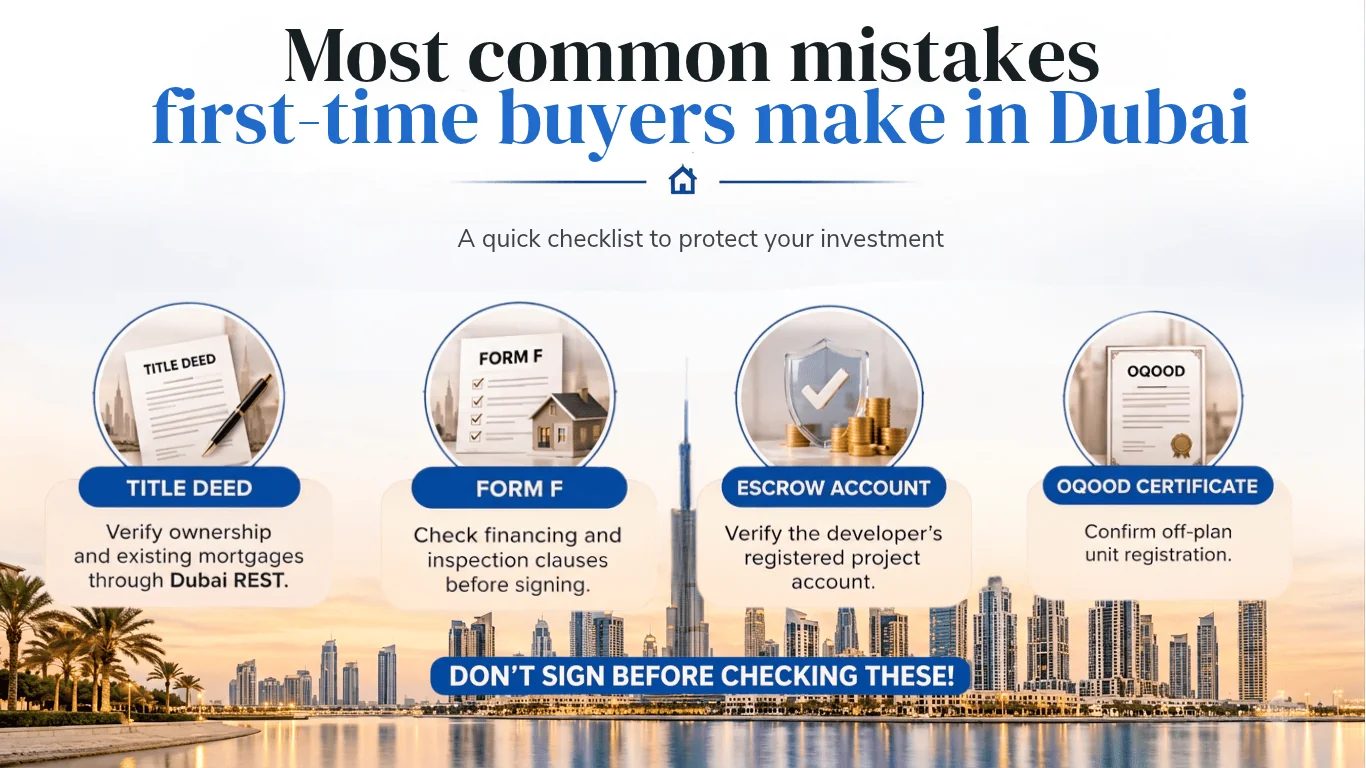
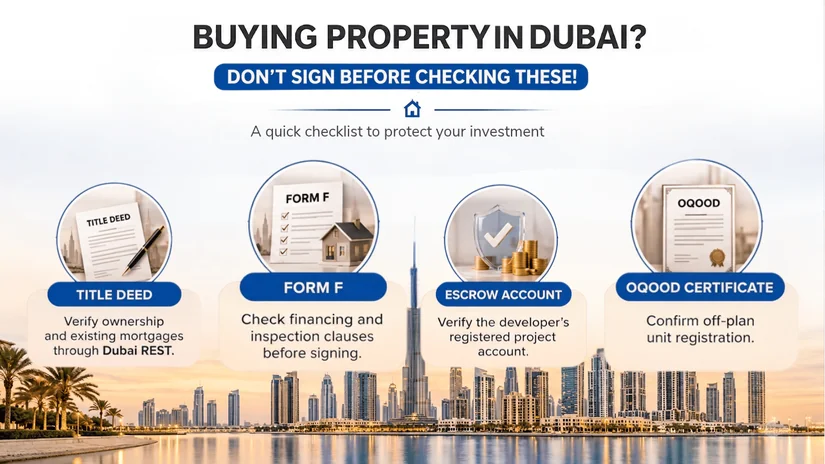
- Never sign an agreement without checking out the Title Deed copy. Before signing any agreement, be sure to get the Title Deed copy from the broker and verify the information immediately through the “Dubai REST” mobile application to ensure there is no current mortgage, charge, or legal block on the document.
- Always count developer service charge dues Check with the vendor that the official clearance letter has been obtained from the developer confirming payment of all charges before closing the deal for the building’s servicing charges and district cooling (Empower/Tabreed) bills.
- Never complete off-plan sale without an Oqood cert. Oqood is your Title Deed registration with DLD of unit before it is built. Always get developer to register your unit on receipt of signing the contract.
Avoiding the most common mistakes first-time buyers make in Dubai
Thinking ahead will make buying property a fun investment of money rather than a frustrating gamble. I showed you how to plan your outgoings to include real closing costs and even how to get your legal zoning rights checked before your contract is signed so your new Dubai home delivers comfort and increased return on your investment.
The most common mistakes first-time buyers make in Dubai usually stem from incomplete information, so adding to the 8% closing fee requirements, putting clauses into your Form F, checking a developer’s track record on official DLD portals and stress-testing your mortgage against future EIBOR increases in the rate reduce the risk of errors to just 10%.
Contact Us Today to book your comprehensive design consultation and explore bespoke spatial solutions tailored to your property.
FAQs
1 Can a real realtor legally charge more than 2% commission in Dubai?
No law caps the commission strictly at 2%, but 2% plus VAT is the universally accepted standard for ready properties. For off-plan properties, the developer usually pays the agent’s commission, meaning the buyer should pay 0% agency fees. Never pay an agent a commission for an off-plan developer purchase.
2 If I buy a rented property, can I move in immediately after transfer?
No. Under Dubai law, you cannot immediately evict a tenant just because you bought the property. You must send them 12-month eviction notice stating your intent to move in for personal use. You will become a landlord for those 12 months.
3 What are the top pitfalls for first-time property buyers in Dubai to watch for?
The most critical pitfalls are failing to budget for the mandatory 7% to 8% in government and agency transaction fees, neglecting annual building service charges on the Mollak system, and failing to verify that off-plan developer payments are routed into a DLD-regulated escrow account.
4) What are the key mistakes to avoid when buying property in Dubai for the first time on a mortgage?
Key mistakes include failing to obtain an independent pre-approval before property hunting, miscalculating the mandatory 20% down payment requirement for expats, and signing Form F without a formal finance contingency clause to protect your 10% security deposit if the bank down-values the property and identifying the key mistakes to avoid when buying property in Dubai for the first time protects your investment long-term.
5) What happens if my mortgage valuation comes back lower than the agreed price, but I didn’t add a clause to Form F?
You are legally bound to complete the purchase at the agreed price. You will have to find the cash difference out of your own pocket. If you cannot secure the cash, you must default on the contract, and the seller has the legal right to cash your 10% security deposit cheque as compensation. Always include a valuation clause.
