
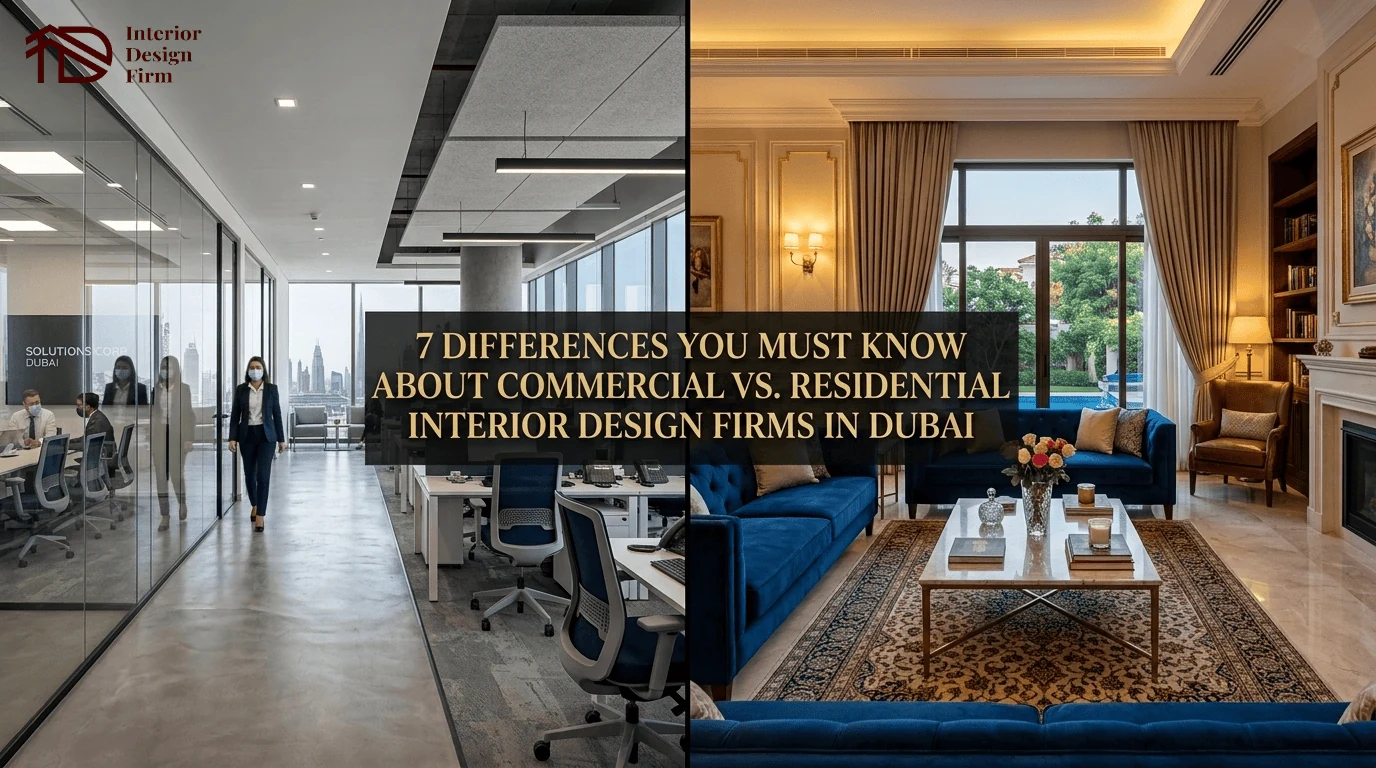
Whether you are a business owner or a homeowner, and whether you have just bought a property or you are renovating an existing one, both situations bring the same moment: turning a space into something that actually works. That usually begins with choosing the right interior design firm in Dubai.
It starts with a conversation, with a partner, a business partner, or yourself, about what is not working and what needs to change. You have probably spent time online looking for ideas. You may have talked to a friend who renovated their house a year ago. You might have tried sourcing items yourself and found there were more obstacles than you expected.
Eventually you search for interior design firms in Dubai and find dozens of portfolios. They all look impressive, which is exactly where the problem starts, and most people only realise it after a significant budget is already committed.
The failure professionals raise most often is a total lack of commercial compliance. Residential designers rarely have the technical training to handle complex commercial regulations. Residential furniture is built for a family, while office furniture has to survive hundreds of people a day.
The reverse is true as well. Commercial firms rarely bring the emotional sensitivity a home needs, because they are built to solve business problems rather than ask how you like to spend your Sunday mornings.
Below are the seven fundamental differences between commercial and residential interior design firms. The goal is to save you from a structural problem, a licensing delay, or a space that simply does not work for you.
1. What Are the Core Objectives of Commercial and Residential Interior Design Firms?
Start with the fundamental difference.
Commercial interior design firms design spaces for business use. Their priorities are functionality, productivity, regulatory compliance, and brand alignment. They work on corporate offices, hotels, restaurants, and public institutions.
Residential interior design firms focus on living spaces, villas, apartments, and penthouses. Their priorities are personalisation, comfort, and the emotional resonance of a home. If you are still shaping a visual direction, our guide to luxury interior design styles covers how each style behaves once it reaches execution.
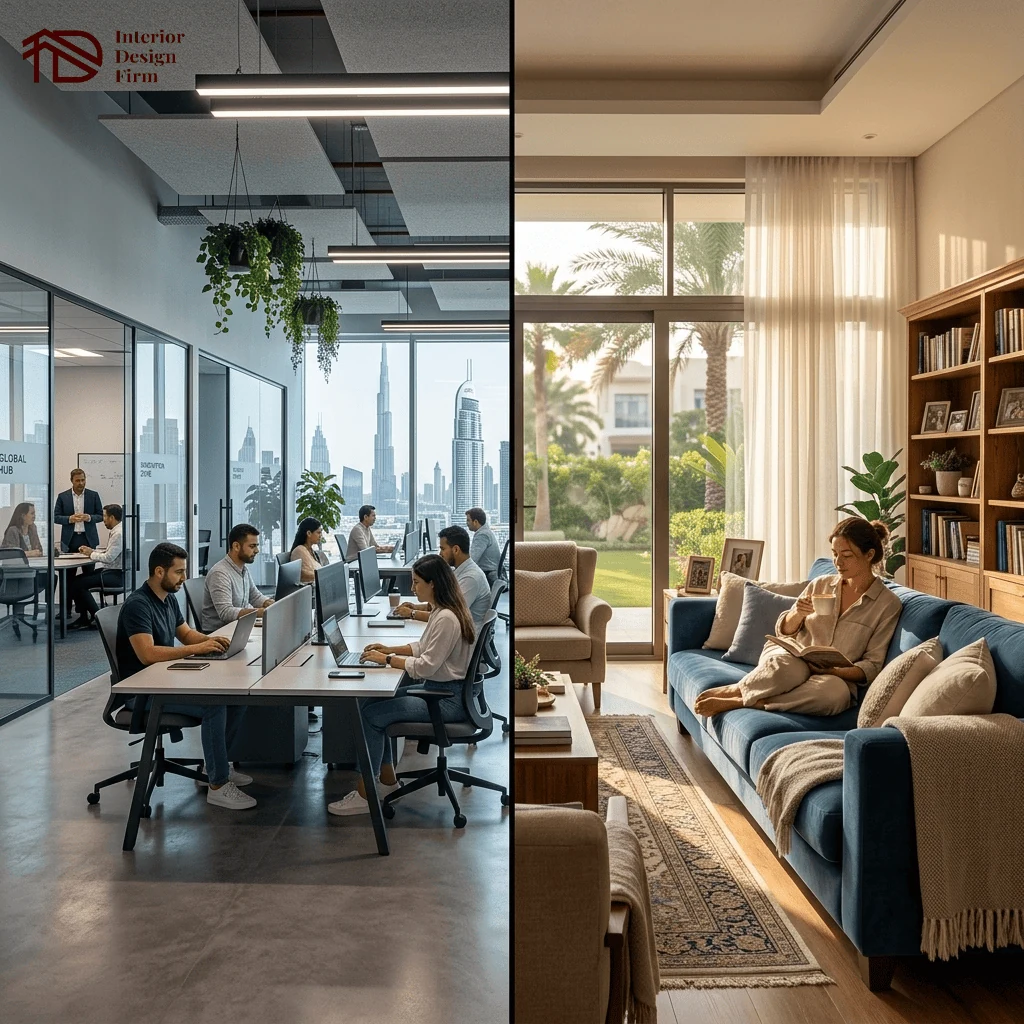
A commercial firm is judged on business metrics. When one designs a co-working space in Dubai, success is not measured by how cosy it feels. It is measured by whether the design helped sign more leases, whether the space communicated the brand to visiting clients, whether acoustics and spatial planning improved team efficiency, and how well the floor area drives revenue.
A commercial designer has to understand your business model. They plan around employee movement, furniture placement, and circulation so people can move freely. They consider ergonomic comfort to reduce sick leave and workplace stress, and they build in adaptable layouts for future growth.
They also think about how layout affects different kinds of work, maximising natural daylight and using natural elements to lower stress and cognitive fatigue, alongside sound management and circadian lighting.
A residential firm focuses on you. The objective is a space that reflects your personality, lifestyle, and taste. They do not ask about the movement of fifty people. They ask how you spend your Sunday mornings, how much storage a particular hobby needs, and which textures help you relax. The return here is emotional, measured in comfort and peace of mind.
Be clear about your primary goal before you approach anyone. If it is revenue and productivity, you need a commercial specialist. If it is your home, choose a residential one. Asking a residential firm to design your clinic means aesthetics will come ahead of medical sanitation standards.
2. Decision Making in Residential vs Commercial Projects
Client complexity is probably the most unexpected difference, especially for anyone new to interior projects.

With a residential firm the relationship is personal and emotional. Usually one or two people make the decisions. A couple saying they dislike a shade of blue is a valid decision point, and the firm adjusts around the owner’s preferences.
A commercial firm rarely deals with a single decision maker. They work with board directors, facility managers, HR heads, project managers, and marketing teams. It is not about personal taste, it is about building consensus and supporting choices with data.
A commercial firm specifies durable high-traffic flooring because it lowers maintenance costs over five years, which fits the long-term financial plan. It selects lighting that supports circadian rhythms, which research links to improved alertness and wellbeing during office hours.
Work out who the real decision makers will be. If multiple departments, budgets, and long-term corporate goals are involved, a dedicated commercial project manager is essential. For a private home, pick a designer who listens and whose taste you trust.
3. Regulations, Approvals, and Compliance
This is the section where a mistake costs months in delays and serious money in fines. In Dubai the regulatory landscape for commercial space is a different world from residential.
A residential firm normally works within community developer guidelines from Emaar, Nakheel, and Dubai Properties, plus Dubai Municipality where structural changes are involved. The focus is aesthetic compliance, safety standards for single-family living, and structural integrity. For a standalone villa, Dubai Municipality and Civil Defence approvals are relatively streamlined when the firm knows what it is doing.
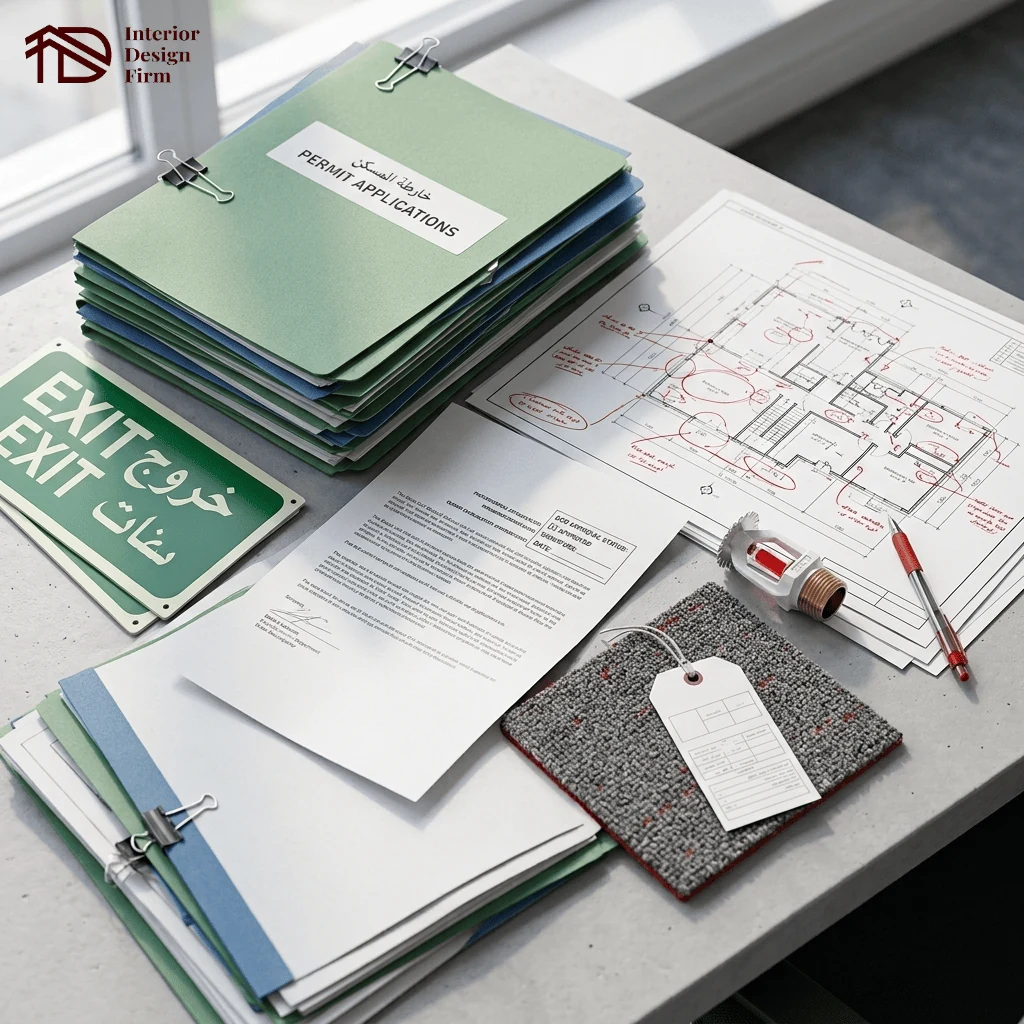
Commercial firms operate under a far larger set of mandatory regulations that shift by industry. Open a restaurant in Dubai International Financial Centre and you need approvals from:
- Dubai Municipality for general structural and health standards.
- Dubai Civil Defence for fire safety, covering sprinklers, smoke alarms, emergency exits, and material fire ratings that must each be reviewed and approved.
- Dubai Health Authority for any medical or wellness facility.
- Department of Economy and Tourism for hotels and tourism establishments.
- Free zone authorities such as Jafza, DMCC, JLT, and Dubai Internet City, each with its own guidelines and in-house approval process.
All of this is a headache for an owner, but commercial firms handle it routinely. They know the required fire rating of a carpet in a public corridor. They understand accessibility requirements under the My Community initiative for retail restrooms. They manage fit-out permits and make sure every trade worker on site has correct documentation. A failure here can halt a project for weeks.
Before signing anything, ask the firm to walk you through their exact approval process for your location and your industry. Uncertainty at that stage is your first red flag.
4. How Space Planning and Functionality Work
Movement through a space is a science for commercial firms and an art for residential ones.
A residential firm plans around the intimacy of home life: the flow from kitchen to dining area, a reading nook, the position of a television against the view. It is qualitative work. Designing a bedroom is about minimising external noise, controlling light for sleep, and building comfort.
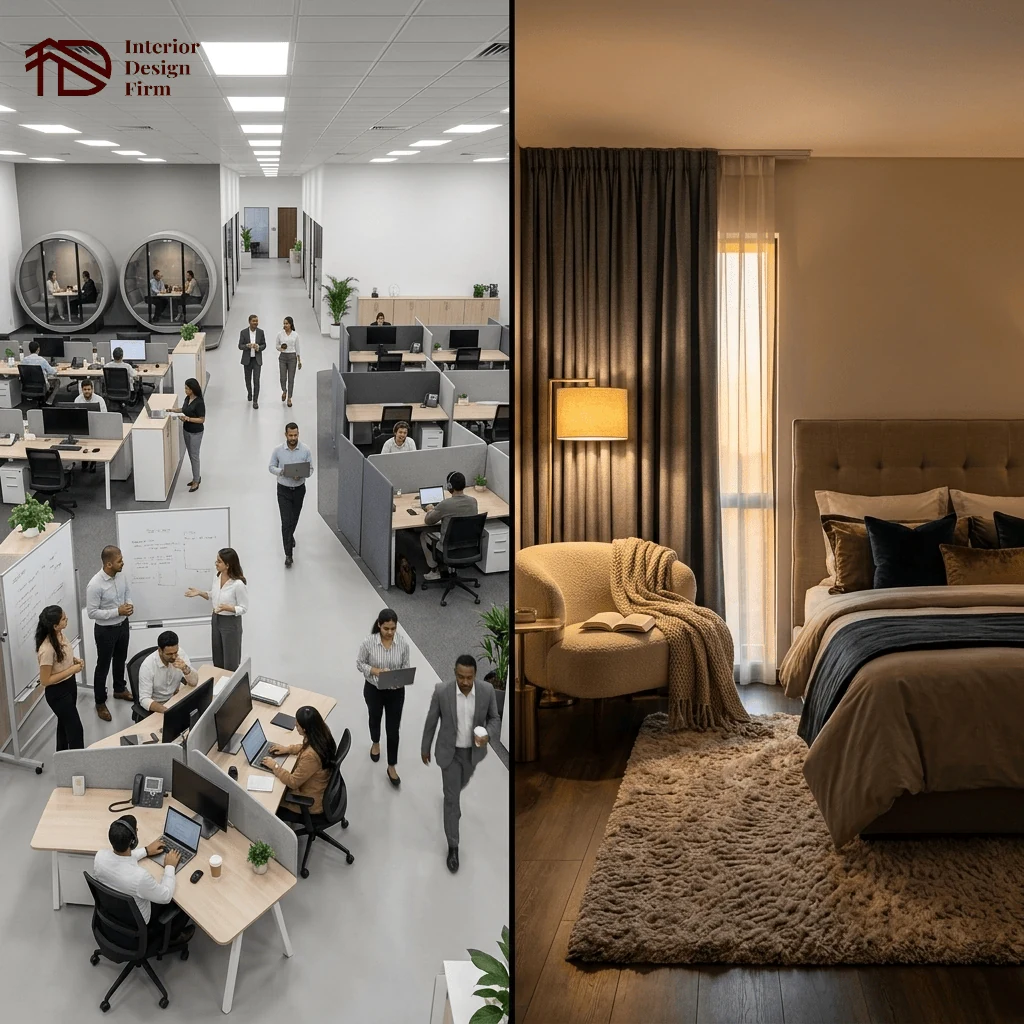
A commercial firm takes a quantitative approach known as spatial programming. For an office they analyse how many people use the space at once and what the legal safety limits are, where employees gather and whether corridors handle that flow, and which departments need adjacency for collaboration against which need quiet for focused work.
That involves acoustic planning, zoning for focus and collaboration, and integrating technology cleanly. It is a logistical puzzle built around operational efficiency.
Ask any firm to show you their space planning process. For commercial work you should see bubble diagrams, occupancy analysis, and evidence-based reasoning for where key areas sit.
5. What Happens When Time Actually Is Money
Pace and process diverge completely. In residential work, timelines are more fluid. The right custom sofa, a hand-knotted rug, a specific vein in a block of Italian marble, all take time, and owners can usually absorb an import delay.

Quality and exclusivity come ahead of speed, budgets flex within reason, and orders tend to be small and bespoke.
A commercial firm has no such room. Every day an office or restaurant is not open is lost revenue and wasted rent. Timelines are aggressive and require tightly coordinated schedules where trades overlap, with painters working in one section while electrical finishes in another.
The logistical challenges are specific to commercial work:
- Sourcing hundreds of identical chairs or workstations.
- Using industry connections to secure cost reductions a single homeowner cannot access.
- Buying from manufacturers who build only to commercial durability standards.
- Delivering heavy items such as large glass panels and bulk joinery into towers or malls, which needs precise arrival times, loading bay allocation, and scheduled night-time work.
A commercial firm runs this from tender, gathering competitive bids from multiple contractors, through project management to final handover. The budget is usually strict and fixed, and holding it is a primary measure of performance.
Look for a proven record on deadlines. Ask for case studies showing a large project delivered on time and within a fixed budget.
6. Materials, Durability, and Longevity
This is where the physical reality of a space gets decided.
A residential firm selects materials for sensory qualities: how they feel, how they read in natural light, how they contribute to a sense of luxury. Silk curtains, hand-loomed wool carpets, and delicate wallpaper all work because a limited number of people handle them.
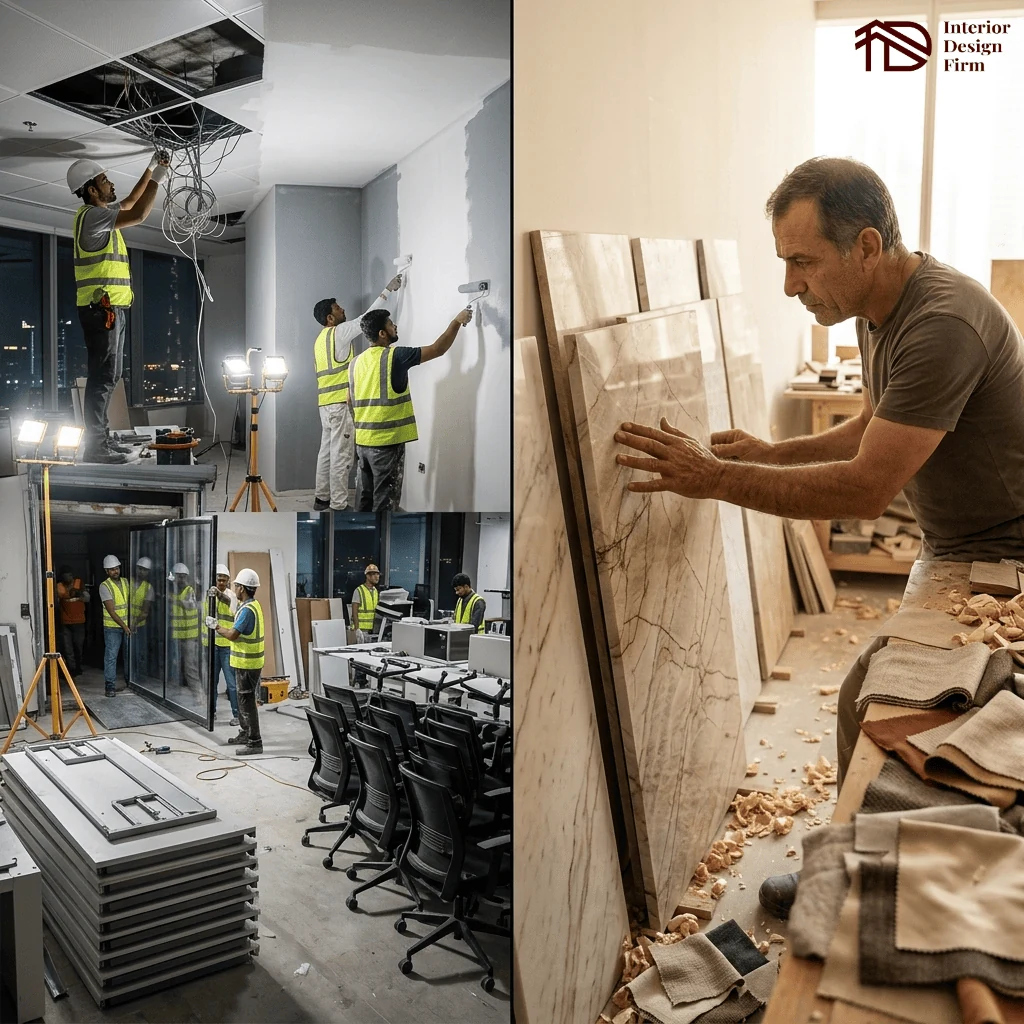
Warranties on furniture and fittings still matter, as does specifying materials that survive Dubai heat on anything exposed.
A commercial firm puts performance and durability first, because material failure is the most frustrating problem Dubai business owners report. Designing a restaurant or a school, the question is not whether a floor looks good. It is whether the specification is commercial grade, whether the paint finish is Level 5, whether the carpet is rated for heavy commercial use.
Wear rating matters, meaning a specific commercial wear layer thickness and proven resistance to scratches, stains, and scuffing from hundreds of shoes. So does maintenance, since finishes need to survive standard commercial cleaning equipment and disinfectants without degrading.
Commercial projects need contract furniture, built by manufacturers who design for eight to twelve hours of daily use and warrant it accordingly. Residential furniture falls apart under that load.
Inspect the firm’s material library and ask about warranties. A firm specifying standard residential items for a high-traffic office corridor is setting you up to fail.
7. Non-Negotiable Factors When You Are Hiring
Now that the differences are clear, how do you actually evaluate a firm? Below are five non-negotiables for each side. If you are weighing a solo designer against a full practice rather than commercial against residential, our comparison of an interior designer vs an interior design firm covers that split, and our roundup of the top interior design firms in Dubai shows how established studios document their work.
Hiring a commercial interior design firm
- A specialist portfolio. If you are building an office, the portfolio should be full of corporate spaces, meeting rooms, and functional workspaces. Do not hire on the strength of residential work alone, or you get an office that looks like a living room and fails on function.
- Verifiable local expertise. Ask which free zone authorities they have worked with recently, and for specifics on DMCC approvals or fire-safety sign-offs. Vague answers tell you what you need to know.
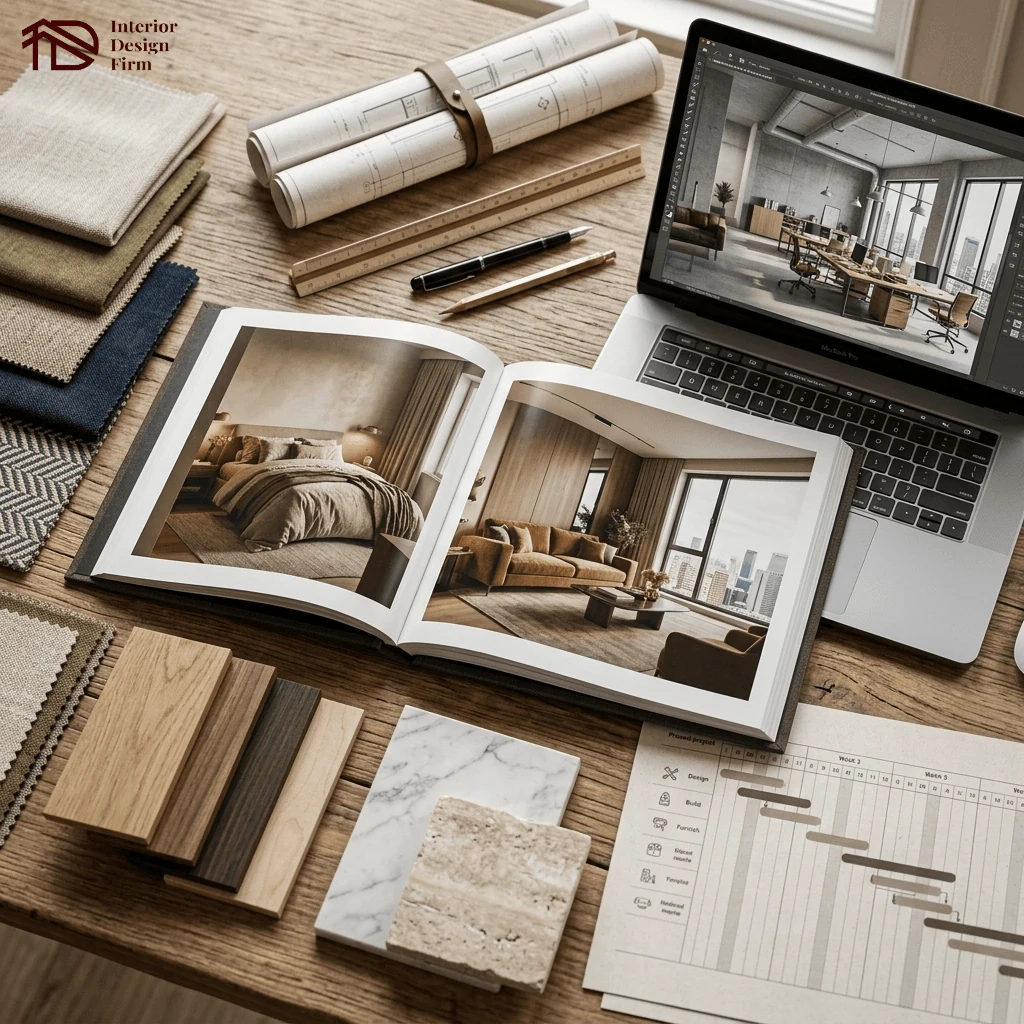
- A clear, phased process. Expect inception and feasibility, concept design, schematic and detailed design, tender and procurement, site supervision, then handover. A firm that cannot articulate this should not be handed a large project.
- Transparent budgeting and contract structure. Look for an itemised fee structure and find out whether they charge a percentage, a flat fee, or hourly. More importantly, ask how change orders are handled. Be wary of all-inclusive pricing that looks too good.
- Technical capability and software. Ask what they actually use. AutoCAD alone for 2D drawings, or Revit for BIM coordination, VR walkthroughs, and acoustic modelling? Larger commercial projects benefit heavily from the latter.
Hiring a residential interior design firm
- Spaces designed for how people actually live. Look for practical storage, materials that are safe around children and pets while still reading as luxurious, and lighting layered for the atmosphere each room needs.
- Approvals handled properly. Residential approvals are simpler than commercial ones, but Dubai master developers still enforce strict rules, including community NOCs for external changes and Dubai Municipality approval for converting wet areas to dry or removing structural walls. An inexperienced designer here means community penalties or a site shut down on day one.
- Joinery and fittings you can inspect. Homes live or die on millwork, wardrobes, kitchen cabinetry, bathroom units, and wall panelling. Ask where the joinery is made, ask to see mock-ups, and check that fittings are specified well enough not to sag or squeak within six months.
- A designer who listens. You will work closely with this person for three to nine months. In the first meeting, notice whether they ask about your routine, daily habits, and storage problems, or go straight to presenting an idea. Feeling unheard early gets worse later.
- Visuals you can judge before installation. Most people cannot read a room from a 2D plan. Expect realistic 3D visuals with accurate lighting and finishes, plus physical sample boards of fabric, wood, stone, and metal you can hold.
The Short Version
The gap between commercial and residential interior design firms in Dubai is not a question of style. It is a difference in objective, process, budget management, and above all regulatory compliance.
Hiring the wrong type of firm leads to material failures, regulatory delays, and a space that does not do its job. Your firm should be a strategic partner rather than a supplier of finishes.
Ask the questions in this guide, refuse to settle for a generalist, and your project stands a far better chance of working both visually and functionally.
Ready to start properly? Whether you are planning a commercial fit-out or a home, Euphoria Interiors runs dedicated specialist teams for each. You can also book a consultation with our team to talk through your property, budget, and timeline.
FAQs
Can one interior design firm do both well?
It is rare, though some large full-service practices run separate dedicated teams for each. True mastery in Dubai usually requires focused specialisation, because residential and corporate expertise is not interchangeable.
Why are commercial fees often different?
Commercial fee structures reflect greater complexity: multiple stakeholders, extensive technical documentation for approvals, rigorous tendering, and compressed timelines. Fees are often front-loaded because of the technical work involved.
How do I know whether a portfolio is real?
Look for multiple angles of the same project rather than one polished photo. Ask to see original unedited images, and request a detailed case study explaining the challenges and how the firm solved them.
Which type of firm is better at predicting trends?
They track different things. Residential firms follow texture, sustainable luxury materials, and personal sanctuary design such as wellness bathrooms. Commercial firms follow agile working, corporate sustainability including LEED certification, and wellness technology aimed at productivity.
As an independent business owner, do I still need a commercial firm?
Yes. A small cafe or boutique faces the same regulations and licensing approvals from Dubai Municipality and Dubai Civil Defence. Without those fit-out permits you cannot open, whatever the size of the business.
